Alloy is Building the World's First Fully Integrated Product Development
Organization - Read the full article
Alloy is Building the World's First Fully Integrated Product Development
Organization - Read the full article
AI/ML in Antibody Discovery: What Works, What Doesn’t, What’s Next

Traditional antibody discovery is a war of attrition: screen thousands of candidates, fail late, and repeat. AI/ML changes that calculus by shifting failures from late and expensive to early and cheap. The result is fewer wet-lab cycles and a higher probability that the molecules you carry forward actually behave like drugs, while at the same time integrating learnings from failures at every stage.
Accelerated Antibody Discovery for Complex Fibrosis Targets

Accelerating Antibody Discovery for Challenging Fibrosis Targets Download Case Study Contact Us Advancing a first-in-class fibrosis program against complex biology This case study highlights how Alloy’s antibody discovery platforms and execution model enabled Mediar Therapeutics to move a complex fibrosis program forward with speed and confidence, despite biological and technical barriers that stalled conventional discovery […]
Leveraging Human Lambda Light Chains in Antibody Discovery
Harnessing the potential of human lambda light chains in antibody discovery Download White Paper Contact Us Expanding antibody discovery potential with human lambda light chains Despite the kappa/lambda ratio in human circulation being between 1.5 and 2, therapeutic antibodies remain heavily biased toward kappa light chain usage. Our white paper explores how Alloy’s ATX-GL platform […]
De-risking antibody discovery through comprehensive developability profiling
De-risking antibody discovery through comprehensive developability profiling Download Tech Note Contact Us Select leads with confidence by integrating biophysical assays, computational analysis, and clinical benchmarking from the earliest stages of discovery. Despite strong target binding, many therapeutic antibodies fail late in development due to preventable issues related to stability, manufacturability, or pharmacokinetics. Alloy’s integrated developability […]
Leveraging Human Lambda Light Chains in Antibody Discovery
Harnessing the potential of human lambda light chains in antibody discovery Download White Paper Contact Us Expanding antibody discovery potential with human lambda light chains Despite the kappa/lambda ratio in human circulation being between 1.5 and 2, therapeutic antibodies remain heavily biased toward kappa light chain usage. Our white paper explores how Alloy’s ATX-GL platform […]
High Velocity AI-Enabled and ML-Powered Therapeutic Antibody Discovery
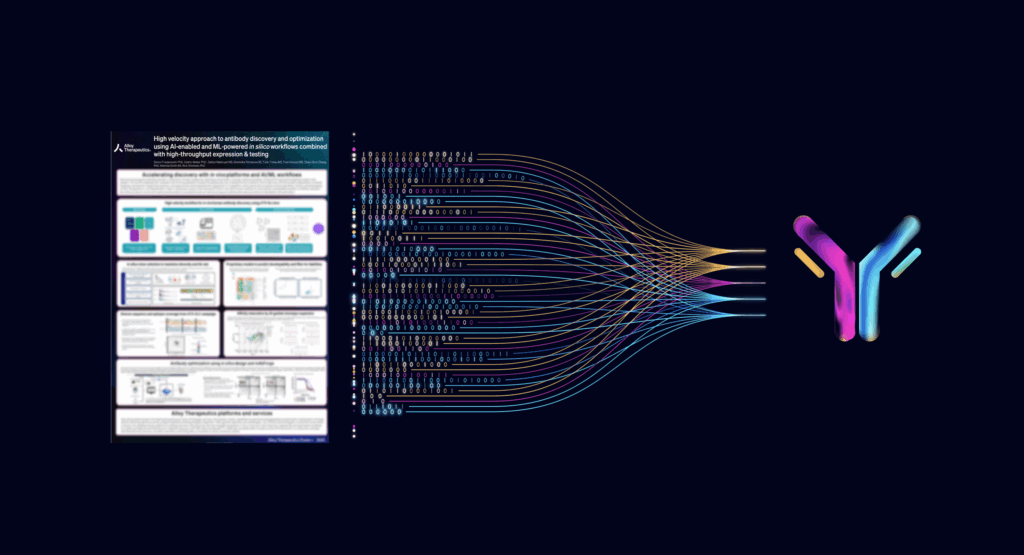
High velocity, AI-enabled and ML-powered therapeutic antibody discovery and optimization Download the poster to see how Al/ML technologies and workflows combined with a proprietary high-throughput screening method accelerate antibody discovery and lead optimization. Download the poster Contact Us AI-enabled and ML-powered antibody discovery for faster and higher quality leads Therapeutic antibody discovery is becoming faster […]
Highly Specific anti-WT1/HLA-A2 TCRm Antibodies

New Data: unlocking the potential of TCRm antibodies Download the poster and explore the discovery of highly specific anti-WT1/HLA-A2 TCR-like antibodies. Download the poster Contact Us Keyway™ TCRm antibody discovery platform is revolutionizing immunotherapy development In a significant study, Alloy Therapeutics researchers identified T Cell Receptor mimic (TCRm) antibodies with exceptional specificity for the Wilms […]
Approaches to Binder Recovery Following Immunization Campaigns in Mouse Models
Harnessing the Potential of Human Lambda Light Chains in Antibody Discovery Campaigns

Targeting GPCRs With DeepImmune™